AQA 7405 & OCR H432 Specialist
A- Level Chemistry
Tutor in Blackburn
Back Titration-step by step
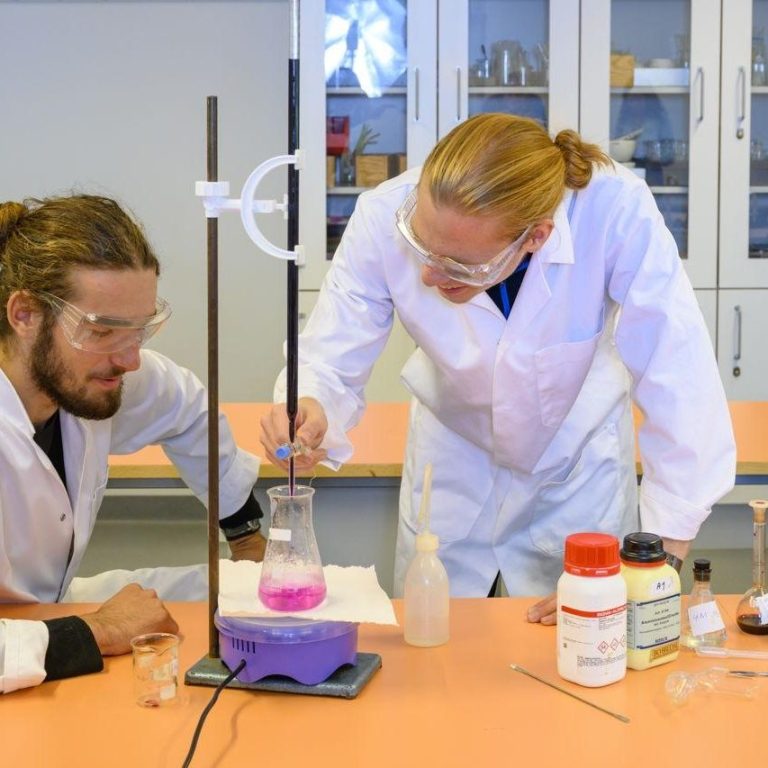
1. Add a known excess amount of a reagent
Example: Add excess hydrochloric acid (HCl) to an impure magnesium carbonate ( MgCO3) sample
2. Reaction occurs between HCl and MgCO3 in the sample
MgCO3 (s) + 2HCl (aq) ----- MgCl2 (aq) + CO2 (g) + H2O (l)
Some HCl is used up and some remains unreacted
3. Titrate the leftover (unreacted) HCl with standard NaOH
in a second titration to determine unreacted HCl moles
NaOH (aq) + HCl (aq)-------- NaCl (aq) + H2O (l)
4. Calculate moles of NaOH
Moles NaOH= Concentration NaOH x Volume NaOH
Calculate moles of HCl originally added at the start
Moles HCl = Concentration HCl x Volume HCl
5. Calculate moles of unreacted HCl using the mole ratio in the second balanced equation: ! NaOH : 1 HCl, the mole ratio is 1:1, which means if moles NaOH = 0.44 then moles unreacted HCl is also = 0.44
6. Moles HCl reacted = Moles HCl added - Moles HCl unreacted
7. Use the mole ratio in the first balanced equation to calculate moles of MgCO3 that reacted with HCl: 2 HCl : 1 MgCO3
The mole ratio is 2:1. If HCl = 0.66 then MgCO3 = 0.33 moles
8. Calculate mass, % purity or composition of the sample
% Purity = Mass of pure substance / Mass of impure sample x 100
Shapes of Molecules - Worked Example
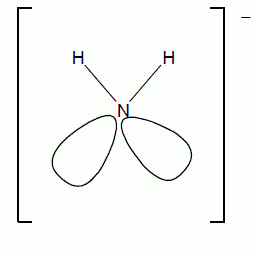
Draw the shape of NH2- ion.
Include any lone pair of electrons that influence the shape.
Predict the bond angle. Justify your prediction
- N is in group 5, so it has 5 electrons in the outer shell
- 2 H atoms provide further 2 electrons
- 1 negative charge provides 1 more electron
- Total 8 electrons in the outer shell give 4 pairs, 2 bonding pairs and 2 lone pairs. Therefore, 4 pairs give tetrahedral shape with bond angle of 109.5° reduced by 5° to 104.5° due to extra repulsion by the 2 lone pairs
Calculate electron pairs around the central N atom:
N = 5
2H = 2
-1 = 1
Total electrons = 5+2+1 = 8
Total electron pairs = 8 / 2 = 4
Bonding electron pairs= 2
(2H atoms around N)
Lone pairs = 2
Shape: V-shape
Bond angle: 104.5°
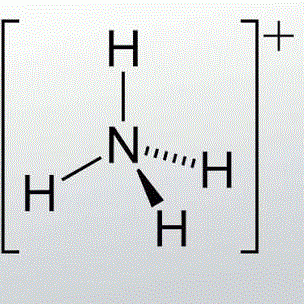
Draw the shape of NH4+ ion. Predict the bond angle
- N is in group 5, so it has 5 electrons in the outer shell
- 4 H provide further 4 electrons
- +1 charge reduces 1 electron
- Total 8 electrons in the outer shell give 4 pairs, 4 bonding pairs and 0 lone pair. Therefore, 4 pairs give tetrahedral shape with bond angle of 109.5°
N = 5
4 H = 4
+1 = -1
Total electrons = 5+4-1 = 8
Total electron pairs = 8 / 2 = 4
Bonding pairs = 4 (3 covalent + 1 dative)
Lone pairs = 0
Shape = Tetrahedral
Bond angle = 109.5°